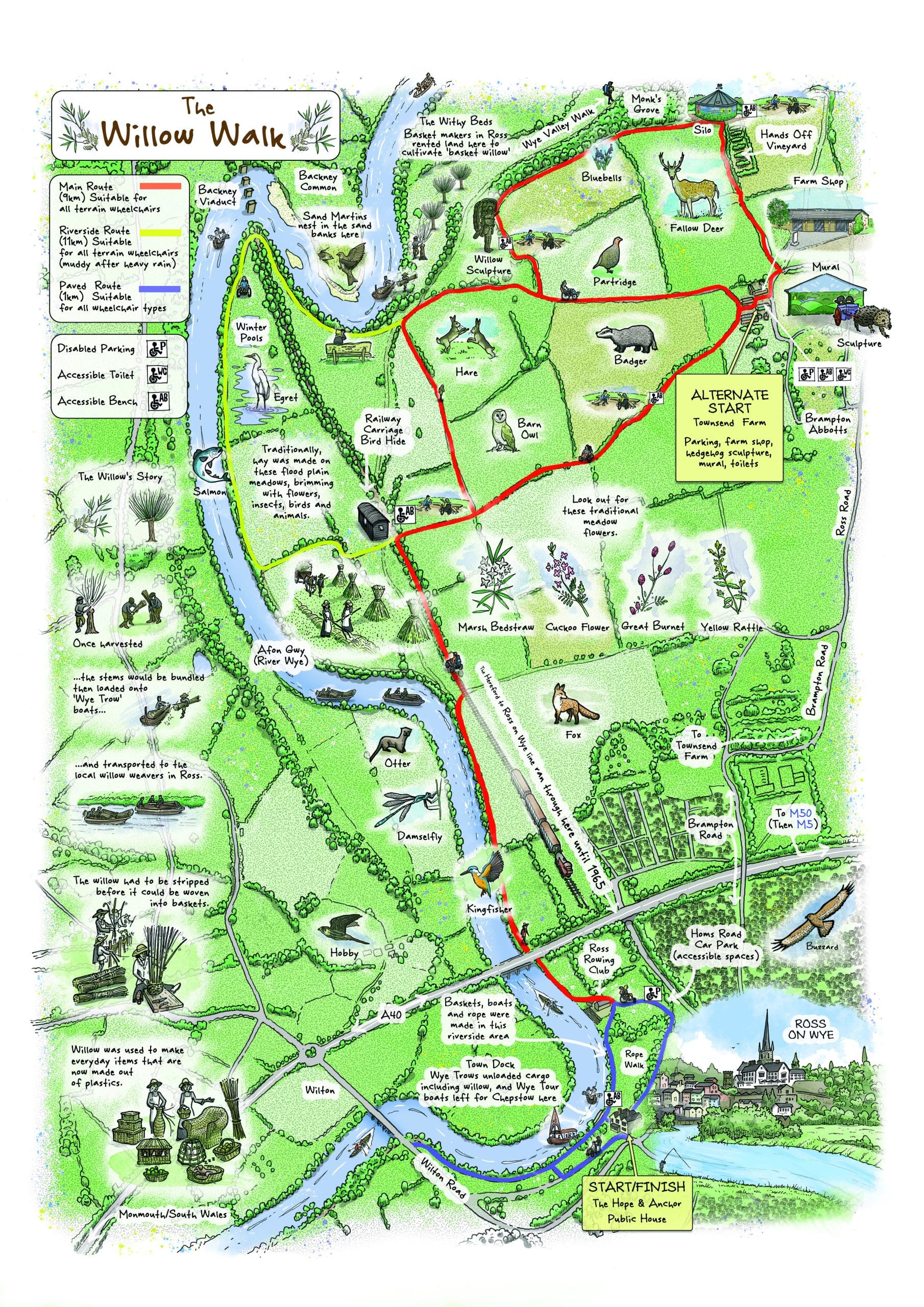
The Willow Walk is a barrier free route following existing paths and tracks from The Rope Walk in Ross-on-Wye to Townsend Farm, Brampton Abbotts.
Spot wildlife along the way. Discover how the willow trees which line the riverbank were cultivated for the local basket making industry. Find out how new ways of farming at Townsend Farm are helping wildlife and nature to thrive.
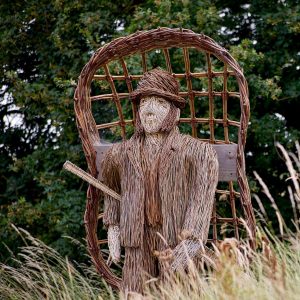
Suitable for all-terrain/ off-road wheelchairs. Follow the Wye upstream across riverside fields and along the old railway to the bird hide. Farm tracks take you around Townsend Farm, passing the Willow Man, the Silo and the New Horizons mural and hedgehog sculptures.
In dry conditions extend your walk by adding this peaceful riverside section, which passes Backney Bridge and the Wye Valley Walk bench. Not suitable for off-road wheelchairs after heavy rain/ river flooding.
You can combine the red and yellow routes to make a longer riverside and farm route (6.5 miles).
For a shorter circular walk start at Townsend Farm and follow the red route.
Craig from Experience Community tested the Willow Walk for off-road wheelchair users. His Photo Trails provide vital information for wheelchair ramblers, through descriptive text, photos and mapping, so that you can make informed decisions about where you would like to go. Check them out below and download the map and leaflet.
Disabled Ramblers have also tried the route and you can view their guide on Outdoor Active.
The Willow Walk brings to life the story of willow and its place in this beautiful riverside landscape. Willow weaving and basket making was an important local industry up to the early 20th Century. Before the age of plastic, willow was the go-to material for making baskets and containers for transporting goods. Coracles, fish traps, furniture and even invalid carriages were woven from willow!
The damp banks of the River Wye provided ideal conditions for willow to grow, especially the Osier Willow, a very bendy variety, which was perfect for basket making. Willow weavers in Ross-on-Wye rented land at Townsend Farm, known as the ‘Withy Beds’, just upstream of the Wye Valley Walk, where they grew willow to make baskets. ‘Withy’ was the name given to the harvested willow. Many of the willows, which in the past were managed for willow weaving, have matured into large trees lining the riverbank.
The photo (right) from the collections of Historic England, show the bark being peeled off the willow, before it could be woven.
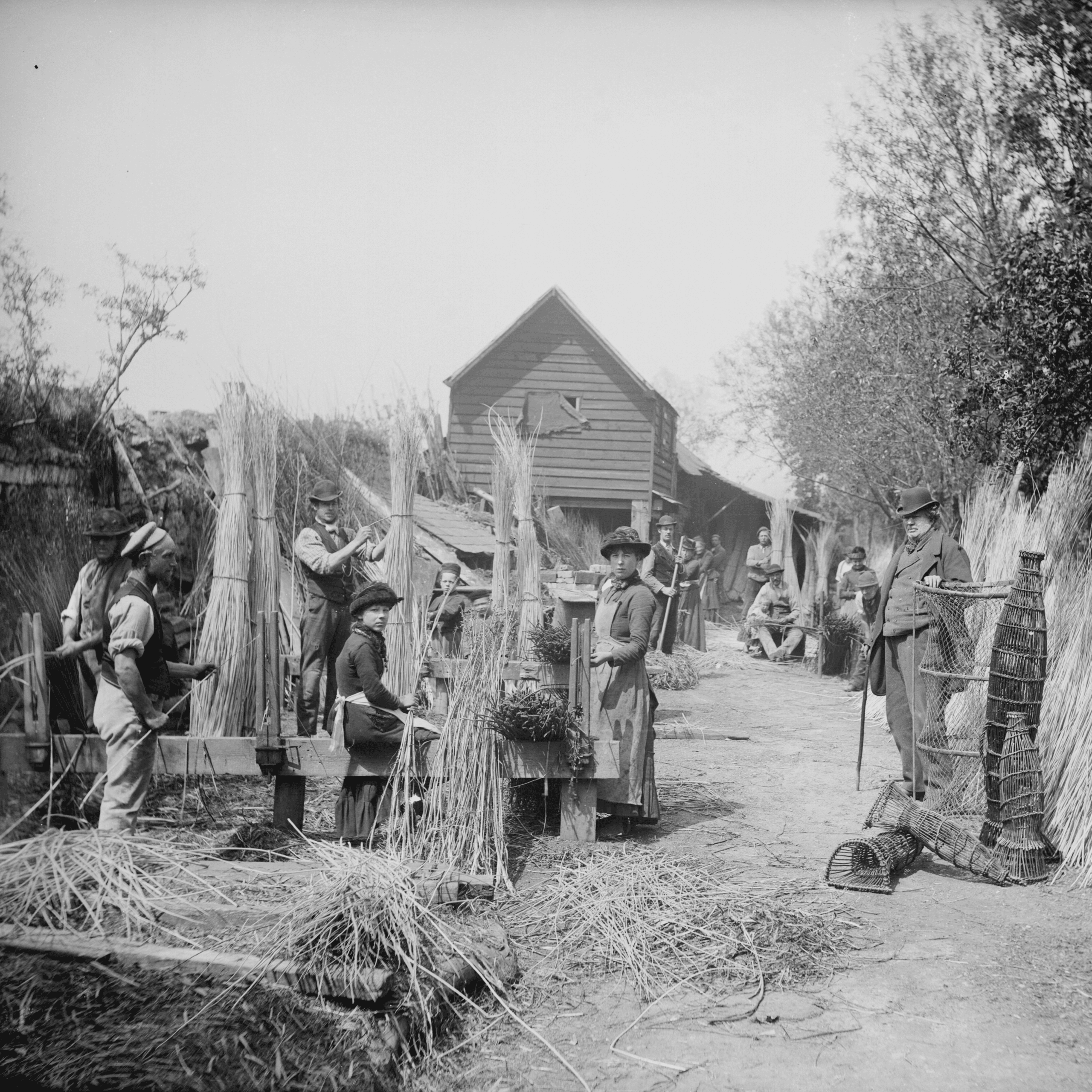
Once harvested the withies were loaded onto flat bottom boats, known as Wye trows, and transported to Ross. The area in front of the Hope and Anchor was the town dock, a bustling place where trows unloaded their cargoes. It was here that the willow weaving industry was located, remembered today by a blue plaque on the Hope and Anchor. Before the withies could be woven the bark needed to be peeled off the slender branches of willow.
Generations of the Newton family from Ross were involved in basket making and willow cultivation. John Newton was recorded as a basket weaver in 1778, whilst Sarah Newton was running a basket and sieve making business at the Hope and Anchor in the 1850s.
The tradition of willow weaving lives on with the creation of a hidden giant for the Willow Walk – the Willow Man who looks out over the Withy Beds fields, where willows still grow. He was woven by willow artist Michelle Cain, and his coracle was made by local willow weaver Lin Powell.